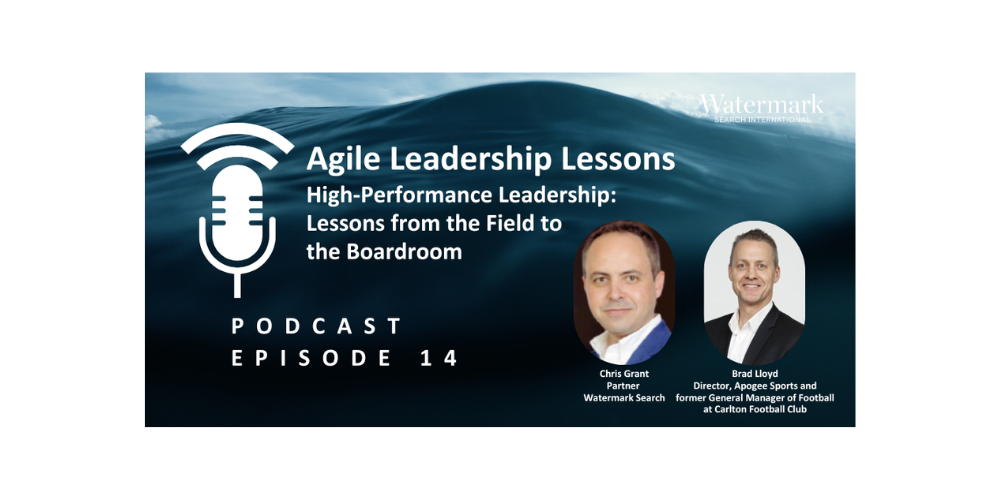
In this episode of Watermark’s Agile Leadership Lessons Podcast, host Chris Grant, Partner Executive Search at Watermark Search, sits down with special guest Brad Lloyd, Director at Apogee Sports, former General Manager of Football at Carlton Football Club, former General Manager List Management at Fremantle Dockers, and former AFL Player Agent at Elite Sports Properties. They have a powerful conversation exploring the crossover between elite sport and modern business leadership.
With an extraordinary year ahead for Australian sport, the pair unpack what executives can learn from the way high performing athletes, coaches and teams operate under pressure. Brad shares how leaders can stay agile when the landscape can shift overnight, how to build and sustain a high performance strategy, and what it really takes to foster resilience and mental toughness within teams.
Chris and Brad discuss the importance of maintaining clarity and energy during stressful periods and how to keep teams engaged and hungry for success, especially when the pace is relentless. The conversation also delves into spotting potential in emerging talent, succession planning with intent and tailoring leadership approaches to individuals while still keeping everyone aligned to a shared purpose. They explore the leadership nuances between AFL and AFLW, the art of giving meaningful feedback and how to lead calmly and confidently when things go wrong. The episode wraps with the universal traits that define effective leaders and the core habits that consistently show up in top performers.
This is a rich, insightful conversation for anyone looking to elevate their leadership game, whether you're in the boardroom, leadership team or on the field.
Listen to gain insights and advice for current and future leaders.
You can also find the podcast on several different apps, Spotify, Apple Podcasts, Breaker, Castbox, Google Podcasts, Overcast, Pocket Casts, and RadioPublic. Click here to listen & subscribe on your favourite app or read the transcript below.
|
High‑Performance Leadership: Lessons from the Field to the Boardroom
Agile Leadership Lessons, Episode 14, transcript:
Chris Grant, Executive Search Partner at Watermark Search International:
Welcome to the Watermark Search Agile Leadership Podcast, where we explore how leaders across diverse sectors adapt, innovate, and thrive in an ever-changing world. My name is Chris Grant, and I'm a Partner in our Melbourne business. Each episode we speak with highly regarded leaders to uncover practical insights that help achieve better business and career outcomes.
At Watermark, many people know us for our work in the executive search world across government, corporate, and non-for-profit sectors. What maybe some might not realise is that we also partner extensively with elite sporting organisations to appoint senior leaders. Right now, we work on a few exciting assignments, including the Chief Executive Officer for the Australian Sports Foundation and Chief Executive Officer for Rugby New Zealand through our colleagues of ours in NZ.
And it's through the work that we conduct and the people we interact with that gives us unique perspectives on leadership in sport and its relevance to business. It is that perspective, working at the intersection of business and elite sport, that really highlights how leadership principles can transcend industries. And that's exactly why today's conversation matters.
In today's episode, I'm joined by Brad Lloyd, one of the most respected leaders in Australian football, and a good friend. Brad has led high performance programs at Carlton Football Club and the Fremantle Dockers. He's been an AFL player, an AFL playing agent and now runs Apogee Sports, helping businesses unlock the strategies and mindset that drive success at the elite level. Brad also currently consults to various football clubs and is a current columnist for the Herald Sun. He's even studied leadership at Harvard and has an MBA from Victoria University. Welcome, Brad, so great to have you on the pod and what an impressive resume.
Brad Lloyd, Director at Apogee Sports and former GM of Football at Carlton Football Club:
Thanks Chris. Yeah, been going for a while now and I know the industry really well.
Chris Grant, Executive Search Partner at Watermark Search International:
Today I am looking forward to our discussion on how adaptability, resilience, and empowerment, the hallmarks of agile leadership, can transform not just sporting teams, but business teams too. Are you ready to get stuck in.
Brad Lloyd, Director at Apogee Sports and former GM of Football at Carlton Football Club:
Yes, definitely.
Chris Grant, Executive Search Partner at Watermark Search International:
Perfect. So Brad, as you well know, elite sports is unpredictable from injuries to form slumps, media scrutiny. How do you lead with agility when the landscape can change literally overnight?
Brad Lloyd, Director at Apogee Sports and former GM of Football at Carlton Football Club:
Yeah, it is challenging. Looking over the years you just never know. As you say, injuries or you have players leave the club again. The recent trade period at Carlton, we had some of our highest talent players leave the organisation, which we, you never would've put into the strategy.
No, you need to have a clear vision, clear strategy. But the big thing I always put in bold is flexibility within the strategy. And a lot of football is about I guess taking advantage of some of the nuances along the way. So yeah, you can't just stick to a plan because it becomes outdated really quickly.
Chris Grant, Executive Search Partner at Watermark Search International:
I like that there's some parallels there for executives facing organisational change. In terms of the programs that you've overseen, performance is obviously non-negotiable. What are the key ingredients of a high performance culture?
Brad Lloyd, Director at Apogee Sports and former GM of Football at Carlton Football Club:
Yeah, look the longer I've been around the one thing players and staff really want, they want a vision and strategy. You'd be surprised. You ask a lot of the athletes they're there to play football and do the best they can, but they really want leadership and they really want a plan to fall in behind.
So as part of that vision and strategy, people focus is important, but everyone needs clear KPIs and know what they're working towards. So there's, every role makes it really performance focused. So if everyone can come in line behind that strategy, it's absolutely critical.
That's one of the important things. And then, I'd say recruiting quality people is massive. And then empowering those people to do their role because, in footy you've got so many experts within the area.
When I think about a football department I break it up into, you've got the recruiting side the list of recruiting. You've got the high performance side. You've got the coaching area, coaching and development. You've got the operational side, and then you've got the wellbeing side. So everyone needs to be really aligned towards the plans. They can all work together, even though they've got their different focus areas.
Chris Grant, Executive Search Partner at Watermark Search International:
Yeah, some great principles there, obviously to help organisations not burn out their teams. I suppose the next question would be resilience and wellbeing. So very good segue and sport demands resilience players bounce back from losses weekly. How do you foster mental toughness and wellbeing in those types of high pressure environments?
Obviously, leading on from what you've just mentioned.
Brad Lloyd, Director at Apogee Sports and former GM of Football at Carlton Football Club:
Yeah. Look, the starting point is, I guess you're gonna know your environment and what sort of people you're bringing into the environment and how many you can cope with that may not be overly resilient. So you need a weight of numbers of really strong leaders and really resilient people within the organisation.
But my brother Simon's actually a qualified sports psychologist and he used to always talk to me about the biggest traits he's seen in the really high achievers. There's two things. One's resilience and the other one's optimism. So people that are optimistic because you, you, yeah, you're gonna get broken legs and you're gonna get you're gonna get dropped and you're going, there's gonna be issues all along the way, even for the high end players and staff.
But if they're optimistic, they can get through and they'll be a good a good teammate as well. Yeah the resilience is really important. Yeah when we are recruiting talent, we're really looking for that on the way in.
The big thing that I look for is competitiveness. Yeah. Real competitors, the people that want to compete and push through. So the other part about leadership is it is a high performance environment. You need to keep people fresh as well. So how do you keep people. Yeah, fit healthy. But then game day is all about performance. So tapering off in the lead up to those big performance occasions to come in really fresh and perform well.
So it's a high accountability environment, but you've gotta support people on the way so you can challenge them in the right.
Chris Grant, Executive Search Partner at Watermark Search International:
And I suppose, for executives that are listening here, what could they learn about sustaining energy and clarity under stress for their teams as well?
Brad Lloyd, Director at Apogee Sports and former GM of Football at Carlton Football Club:
I've been lucky to work in a environment that's all about health and fitness. And the AFL / AFLW the running game. The running game's here to stay. So you need to be fit and strong and healthy. So that's important. And staff normally go get involved there.
But I do see a lot of corporates that aren't fit. They're you look at them and they've got really high pressure, high demanding jobs and they could be really overweight, not good habits, too much alcohol, too much whatever it may be. So I, just a healthy lifestyle is a really starting point.
You've gotta really treat yourself like a high performance athlete in these big demanding roles. The greatest example I've seen of that is a guy who's a friend of mine from Chemist Warehouse. He's in a really important role. I think he's a COO there now and he's so fit and healthy and he loves his marathon running and I think it allows him to thrive in the role day to day as well.
Yeah I'd encourage as a starting point, a real healthy lifestyle. When you go into your organisation you're ready to cope with the demands because fatigue and set in really quickly under those pressure situation. It's probably on our wellbeing and health is important in big organisations. But yeah, it's really important for your senior leaders.
Chris Grant, Executive Search Partner at Watermark Search International:
Yeah, I like that the wellbeing tokens in the bank that you undoubtedly withdraw from time to time. I suppose next I'd like to talk about talent and adaptability. Obviously this is closer to home for myself and for you as well. As you've been involved in recruiting and developing talent in the AFL, now that's a long game. How do you balance the short term performance expectations with long term growth, particularly in the club setting?
Brad Lloyd, Director at Apogee Sports and former GM of Football at Carlton Football Club:
Yeah. In football club and football department, that vision and strategy is really important, so everyone's on the same page, so you'll have a vision and strategy. You'll have a football executive team that with some of those roles I've mentioned before that, be mainly being the senior coach and GM of football and head of recruiting and head of high performance and you've got the CEO and the president.
So everyone needs to be really aligned with what that vision looks like. And then we'll have a list management model in regards to how we're building the playing list. For instance, if you've got a top 10 pick you work through, what do you really need to fill out with that long term list management model?
A common saying in sport, in in AFL really, is draft for talent and trade for needs. So a little bit separate, but you've got your recruiting manager that's into the draft and they wanna find the best 18-year-old in the country to add to the list. And then you've got your list manager who's looking at a ready-made player. So as the general manager of football you're getting those two views together and aligning to work out what's best for the club. With the longer term plan and where you're going. Sometimes it might be good to get an established player because you're in a bit of a window where you think you can win next year and be really successful.
And other times you might be in more of a build where you'll take the best 18-year-old and get a 15 year career out of that player. So it's all about I guess alignment of all the roles. So you make a really clear decision on where you're heading.
Chris Grant, Executive Search Partner at Watermark Search International:
Great. And I suppose, what's the lesson do you believe, for succession planning and leadership pipelines in a business context?
Brad Lloyd, Director at Apogee Sports and former GM of Football at Carlton Football Club:
Yeah, I guess you certainly need a model on how to view your current staff and so I would think the one thing that's underrated in professional sport is retention. So yeah, I guess mapping out in footy or we often have A graders, B graders, C graders, D graders and rank them accordingly.
If you've got your A's and B graders making sure they're looked after, they're retained they're part of the long term plan and they need that and they know that. And then you'll have some other roles that you need to fill. So that's really important. So that's no different.
You can do that in an organisation where really highlighting who are the really important roles who are the people that could really develop. And I guess who are the ones that may not be in the right place at the moment and may need to look at another opportunity elsewhere.
So once you identify those gaps, then you can go to work on, on, on filling as well. But I think staff appreciate that as well, that they know there's long-term planning and long-term development and they can develop through the organisation as well. So I think it suits everyone. So I have sat in meetings where really experienced board members have seen list management strategies that football clubs used and say, I could take this back to our organisation and do similar.
So it's done to the nth degree and in sport because things move really quickly and you may think you've got a star and they get injured or they leave and you've gotta fill that role.
Chris Grant, Executive Search Partner at Watermark Search International:
Yeah, absolutely. I think retention, as you rightfully say, is probably an area that a lot of organisations look at when there's a war for talent or where talent's really hard to come by, but not necessarily, you know, over the whole course. It's a little bit like onboarding. There's a lot of focus on getting the right person.
Obviously they invest a lot in the recruitment cycle but almost the job is done. The box is ticked. Once they accept the offer where there's so much work to be done from that point on to ensure that they're a success. Here's another follow up question close to my heart, as an executive recruiter, and I know that you've been involved extensively in recruitment over the years.
I'm keen to understand what traits you look for in young players as you've got a particularly informed view, I believe having been a former player yourself, a player agent, a football operations director. So you've seen it from multiple angles. So what are the trademarks of exceptional leadership talent and do you feel that there are any lessons that are applicable to organisations looking to steal the playbook and or appoint their next generation of leaders?
Brad Lloyd, Director at Apogee Sports and former GM of Football at Carlton Football Club:
Yeah. Like when we're recruiting talent, we'll there's a lot of getting organised part of it. What are you looking for and how do you set the roster of your scouts on where they're going to and what games they'll go to. And sometimes you're choosing games on the conditions as well. So you can go to really clean grounds where you know you're gonna see the players in their best light. But yeah, we look at their football side obviously, and their skill level and what their output is. So they might look good, but are they delivering?
The running capacity for players, so I have a lot of friends will ask about kids or junior players and, oh, they're gonna play AFL for sure, but or AFLW. But the running capacity of these players is absolutely elite. So they're either elite sprinters or they're elite endurance runners. And they're strong and sometimes even you look at their hips, have they got big, wide hips that are built for contact or like a Lachie Neale in the midfield or they're a bit light and can be easily tackled.
So you're looking at you're looking at their football, their output, their running capacity, and you're looking at their character as well. Are they built for the environment. It can be a grind day in, day out. You need to be relentless. And it's a relentless environment. So they can cope with the demands.
And then there's also the I guess the education side. How can they learn and can they come in and learn a game plan and play their role. If you've got all of those things, you're probably the number one draft pick. So you don't have everything. But I would come back to, that competitiveness angle, I've said they've gotta be at a high enough level of skill level and football ability and football smarts.
But if they've got that with that that competitiveness and they've gotta really love the game as well. The game's too hard if they're not really into it. That's one thing you're looking for because when they come through to us in a draft. There's a lot of high-end players, the best players in the country, both men and women. And so you're really looking at the character traits to see if they can carve out a career at the highest level. And, some of these players the men's, they're 18 year olds and running out in front of 90 plus thousand people. So it's a big role they need to play.
Chris Grant, Executive Search Partner at Watermark Search International:
Yeah, just as you were saying that, I was reflecting on my football watching days in the eighties and nineties, the game has moved on from the Tony Locketts, hasn't it.
Brad Lloyd, Director at Apogee Sports and former GM of Football at Carlton Football Club:
Oh, there has, yeah. There's probably yeah, there's probably always room for him. He's looking pretty lean and mobile at the moment, Tony. But no, the game has developed, but though it hasn't at the same time. These guys are enormously footy smart, and they're powerful.
Like Tony, he'd do probably adjust some training, but he had really powerful repeat speed and beautiful skills. And yeah, real competitive streak. So the big thing this competitiveness you're not looking for all privately educated, players that have they come from all walks of life. And some of the people that haven't been great at school are the most footy smart people you come across. So you need to really take that all in as part of your, building a character base on these players.
Chris Grant, Executive Search Partner at Watermark Search International:
Yeah, absolutely. I suppose when you're building a character base, you've got some time, et cetera.
Next set of questions I'd like to ask you is more related to decision making under pressure and in elite sport, decisions are often needed to be made in seconds with incomplete information. So how can business leaders replicate that ability to make confident, repeatable, as you say, agile decisions when the stakes are high?
Brad Lloyd, Director at Apogee Sports and former GM of Football at Carlton Football Club:
Yeah. I think your process needs to be strong. So we have one thing I'd compare it to in AFL. Like we have a draft and trade period where it's live trading on the night, so you're having to make decisions on the clock to trade a player or to slide out draft picks or slide in draft picks. But it all comes back to a process.
So you're planning as much as you can in the lead up. And I see coaches you wish them all the luck. You wish them luck before a game and often they can't do much more once the game starts because the players are they've been coached all week on it.
So it is then up to them to deliver in the moment. For the football side, I think about training reflecting match intensity, training reflecting the physical demands, and training reflecting decision making even towards how many numbers you have in drills to make it really similar to a game.
Now how that reflects back to business is difficult when you're running out there in a game sense. But I would say your processes and getting them really strong help you be able to make I guess quick decisions at the time because I think a lot of gut instinct comes from wisdom. It's yeah, you think it's gut, but it's not as loose as that. It's yeah, it's wisdom from over the years and strong processes that help you make the decision.
I think it's having a good plan, having good alignment with your senior leaders. It's having good, calm decision makers as well. So yeah, the character of your leader is really important and having a good process, and that'll allow you to make decisions pretty quick. But they're well thought out.
Chris Grant, Executive Search Partner at Watermark Search International:
Yeah. I suppose that's a really important point, isn't it? Because you turn the news on every day and that we're moving more into a data and AI driven world. But you still need that human judgment. So I like that as a lesson for executives. Thanks for making mention of it.
Now, leadership in transition. You've led through coaching changes, cultural resets. You've done reviews even more recently. You've done reviews. So what strategies help leaders maintain trust and momentum during periods of major change?
Brad Lloyd, Director at Apogee Sports and former GM of Football at Carlton Football Club:
Yeah. I think communication is critical. Like I've have been through a lot of reviews on departments I've run, and also I've conducted a few reviews myself. It's hard, but I think, yeah, starting from position of trust is really important. So how can you come in or be part of a group that can create a really trusting environment.
As a leader if you are in that situation potentially being reviewed, you need to embrace it and get all your management and staff on board with all of that. So that's really important.
And then the communication all the way through. So often you don't need to say a lot, but you just need to keep communicating with people on what is going on. Because some of these situations, but it's a huge - all the reviews I've been involved in, I've never had a bad one in regards to it's always been the biggest opportunities of growth and learning. So I'll reinforce that now to people. And I did a review recently at a club and the players and staff loved, they loved the opportunity. They felt really valued by the organisation that the club was taking this stand, that we're making this effort to invest in the program. And, the other thing too is having a presence as well. Making sure you are, you need to be available, you need to be on the ground to talk to people and be present because I guess a fair bit of anxiety can be around when there's change going on.
Yeah, I would say, try and build trust over communicate as much as you can. And really the final one is often reviews are done or there's culture surveys and people never receive the feedback and they can get fatigued from that. So I think the communicating back the findings and what you're working on. Making them part of that, and you might have an action group to get these things up and going. So I think that's really important as well because otherwise people get sick of filling in surveys and nothing ever happens.
Chris Grant, Executive Search Partner at Watermark Search International:
Yeah, 100% agree. The feedback that I get from candidates that are looking I wouldn't say often, but has been in the past, that they were fully invested in the organisation did a bit of a cultural reset, which the individual didn't think was a bad thing and then filled in all manner of information and then never heard anything back, fizzled. And then, three months later they were, doing another pulse survey or what have you, and they just were uninterested anymore. Because they didn't feel that their opinion mattered. And I suppose that led to a number of changes that then led them to me.
Yeah, I think that there's a lot of lessons in that particular comment. Brad, I'm interested a little bit of a segue, but you've looked at and reviewed both codes of football. So what do you believe are the differences between the two codes of football in AFLW and AFL?
Brad Lloyd, Director at Apogee Sports and former GM of Football at Carlton Football Club:
And I've mentioned this to you earlier and this is a line and I'll steal it from someone that the AFL that mentioned it to me recently, but, and I thought it was pertinent. But it is men need to perform to belong and women need to belong to perform. And that was a comment that, it gets banded around a little bit in the men's and women's circles now, but I, I feel the yeah that's something that in the AFLW, it's been a really hard slog over the years for players coming through. And there was players that weren't able to play footy back 15, 20 years ago.
They had to stop playing and then now they're in and they're playing AFLW footy. And so now it's all about integration. Integrating the both programs and have, really equal. And that sense of belonging is really critical. And I find the women's teams when they have that sense of belonging that'll transfer onto the field. So that's something all clubs are really focusing on.
A comment that was made to me over the last sort of year or two and, comes up a fair bit and I think it's whoever first come up with it. I think it might've been Alan McConnell, who's up in GWS, but yeah, it's really important.
So yeah both programs are critical. The growth of the women's game in AFL has been enormous. When you see, you go to the local grounds and women coming through so many young girls playing and the skill level, and now you look at AFLW football and the younger players are the ones having a real impact.
Yeah, culturally, it's and the men's program loved having the women's programs around and it's good for them and it's good for that cultural diversity as well. So that's a big movement that's happening in AFL at the moment.
Chris Grant, Executive Search Partner at Watermark Search International:
Absolutely. It's funny, as you mentioned that I hadn't come across that saying. Men need to perform to belong and women need to belong to perform. But if I reflect on my career and the careers of others that I've placed, oftentimes they talk about monkey off your back once they've accomplished something of significance.
And it's particularly, I hear it a lot from men more so men obviously still important for anyone in a new role. But oftentimes that is the case, isn't it? That you need to be fulfill perform as a male to feel like you can belong in that organisation. So speaks to culture and I think there's a lot being done in culture, but a lot more needs to be done.
And I suppose. Managing for diverse personalities is never an easy thing either. And a football list is full of different personalities and motivations, and we see it playing out in the news cycle and the like. How do you tailor leadership to individuals while keeping everyone aligned to a common goal? That can't be easy.
Brad Lloyd, Director at Apogee Sports and former GM of Football at Carlton Football Club:
Yeah, particularly in the GM of football role you're dealing with the board, you're dealing with the CEO. You're dealing with your football executive team and staff, and then you've got all the players and everyone's, within them, they've all got different attention spans to it all as well.
I look at some of the players meetings are really short and punchy. You might not have meetings longer than 20 minutes. But the playing group, because you're getting a whole group together. Young men, women, 18 to 25 years of age and you're having to treat them differently to If you were sitting in an executive meeting for a couple of hours, it's a different. It's a different style. So yeah, you're taking different approaches depending on the stakeholder as well. So it comes back to vision and strategy. We're all working to the same goal.
There's alignment throughout there. Everyone's got different capabilities that you're trying to develop. And then I, I've mentioned competitiveness a fair bit there, but you're looking to what makes each person tick with getting that competitiveness out of them?
I work a lot through the leadership groups as well. We'll have a a playing leadership group, a half a dozen players, and I try and drive a lot of the standards through the leadership group so they can enforce that to the players. Gone are the days where the footy manager can get up in front of the group and I guess deliver a bit of a sermon on things and expect to get a result.
Often you're using the peers to you'll get a better result there. Yeah, so it's that's really important. But the main thing is if through the leaders you can get a shared understanding of what are the standards and behaviours that we want as a playing group and as a staff group, and really getting your leaders to drive that. And then everyone coming in behind that. That can really create a really strong culture. And that strong leadership that sort of develops everyone is really important.
And, I think as well, just trying to get as many quality people into the organisation. Just really good staff, really good players, good quality people. And every now and then you might take a bit of a risk with someone that's got some talent that you think you can use, but it's a weight of numbers thing. You don't want to have five of those. And all of a sudden it starts eroding what you're trying to do. Because you want to win that person over as well, that builds into the fabric of the club.
So yeah, it's leadership is challenging. But it's important to have a really good plan that everyone can fall in behind, and set at the start. Like I've having some really good KPIs and measurements, even the most yeah, youngest of players and whether you're long term player, a new player, everyone wants a plan to work towards. So it's important that that players see that.
Chris Grant, Executive Search Partner at Watermark Search International:
Yeah, perfect. And definitely there's a lot of things to take away there in terms of leadership standards and behaviours. Setting it from the top. You've got your plan you're executing against, and then you're understanding individual's motivations. And then you've got the season. So season after season players need to stay motivated and it's hard to keep on top of the motivation, week in, week out. What techniques from sport do you think can help business leaders keep teams engaged and hungry for success over the long term?
Brad Lloyd, Director at Apogee Sports and former GM of Football at Carlton Football Club:
It is harder, particularly when you've got, yeah, you may not have a new coach. You may have a coach that's been there for a little while. And obviously the vision I've talked about is important, but often coaches you'll see them have themes. They might have a pre-season theme or they might theme this the actual season.
So yeah, you've seen coaches like Alastair Clarkson and Luke Beveridge and these types of characters are quite good at theming and getting the players, the players motivated towards something and often because it's a long season. Like even with a vision, you might break it up into, instead of a five year vision, you might break it up into a two plus three.
So it's a, okay let's get the vision going for a couple of years and then sort the strategy and then we'll accelerate out of that with another plan. But, you break it into blocks, often as a club, you might say, okay, these are our first four games. Let's just focus on that. That's our block. Then we get a rest in, then we'll go to the next block.
Sometimes you put a bit of money into training camps where you get everyone away. It's not just about the training, but it's about getting everyone together, building things culturally. Spending time. And yeah, freshening players up as well rather than that sort of grind.
So you're working all different ways depending on what's required to keep everyone really connected. Because the biggest thing when teams can turn things around or can really get momentum is buy in. Particularly defensively if you want teams to all defend together, they've all gotta buy into a set plan.
So that's no different in in business as well. Like how do you get, all the staff to buy into the purpose and the plan and playing their role. And so you, using little tricks to repackage what is happening all the time. And I come back as well to, to measurements as well that sometimes people can be, although they want KPIs and measurements and be able to aim towards something and revisit that as well.
So I think that's really important and, we talked earlier about trust. I think if management have a really good trusting relationship with their people as well, they can have they can have those conversations that need to be had as well. If the hard conversations if any of their people are struggling.
Chris Grant, Executive Search Partner at Watermark Search International:
Yeah, trust is obviously fundamental to any relationship. The buy-in is an interesting one. Obviously ideally you want everyone to buy in, but what's the kind of micro skill for buy-in? Is it that you ask their opinion? It comes back to a little bit what you'd said before, right?
You go out and you survey people, and then they say something and you never actually go back to them with any feedback. They lose interest. So is that the opposite. Do you then okay, great leadership group, we've got your take now we're gonna go to the players, we need them to buy in, we're gonna get their take on it.
And then, you've got those trust tokens in the bank. They give their take, and then you give them feedback in real time. Like how does that work to get buy in?
Brad Lloyd, Director at Apogee Sports and former GM of Football at Carlton Football Club:
Yeah. Look, I think at the start, the leader needs to have real clarity on what they're after. So in football, how does the senior coach want the team to play and have real clarity on that? And this is our game model. And this is based on, the personnel that we've got, but also the trends and where things are going. That needs to be really clear. And then the next step is just to, to get alignment and starting with the leaders, maybe take taking them through that and getting their feedback their buy-in.
But you wanna be coming with a, not getting them to make it up but saying, this is how I want to go. What are your thoughts? And get really clear buy-in from the leaders and then from there you'd take that to the playing group to say, this is the plan and this is the reasoning and this is the rationale.
And just get full buy-in from there. And then along the way there's revisiting on a very regular, like a weekly basis. Like how are we going to the plan? How have we performed? And then probably different to the old days where there was a lot more confronting feedback. Whereas now it's players love seeing their teammates acknowledged for their role. So often in team meetings, the role players will get acknowledged for they might be the tackling forward or the rebounding defender, but getting acknowledged for the role they're playing. And putting that up in lights to say look what they're doing. And just constantly reinforcing that they're sticking to the model but also highlighting, okay, this is where it's breaking down and getting back to it.
So you'll find in football clubs on a daily basis, it's that alignment's reinforced time and time again. And the behaviours are rewarded time and time again. And less than rewarding, but every now and then there'll be times when you have to address some poor behaviour or going against the plan. And it's really important to do that in the right way because everyone's watching and everyone's watching to see. Players do get frustrated as well when things go un unchecked for long periods of time and the coach or the GM hasn't addressed the behaviour. So that's something that's important as well to keep everyone on track.
Chris Grant, Executive Search Partner at Watermark Search International:
Yeah that's really interesting. There's that adage, right? The common saying, praise in public critique in private. Is that how it works in sport? Or do you need to call it out publicly when you're seeing poor behaviour? How does that actually work?
Brad Lloyd, Director at Apogee Sports and former GM of Football at Carlton Football Club:
Yeah, it's, I'd say it's less so these days. The public, the poor behaviour part and depends on the situation. But yeah, certainly the praising publicly. But yeah, the there's a lot of, I think from a trust and respect and doing things, a culture, you wanna make it a culturally safe place as well.
So yeah, berating players publicly, or you'll find coaches often publicly in the media, they'll really back their people and their players. But then behind the closed doors, they'll, that's where they'll address things. So sometimes there's a requirement and education for the group to, to address it in front of everyone. But I think those addressing things that way would be more towards some behaviours that really go against things culturally. But if it's a skill error or it's something that someone is trying their best on, that'll be just in a private conversation and, and keep empowering that person.
But yeah, I'd say there's a lot more yeah, a lot more praise than the berating these days. But in saying that players and staff thrive on feedback. They're desperate. It's the one thing that, now they're always yearning. But you can do that in the right way.
Chris Grant, Executive Search Partner at Watermark Search International:
Yeah I like the celebrating of the small wins is particularly effective. We saw that in a different organisational context and particularly important through COVID actually bringing people together. The small wins, obviously, there's a lot of dire news out there. And that was particularly important to building culture and bringing people together and getting them behind a plan.
I suppose just on that point of when things do go wrong, whether that's injuries, poor form, media pressure how do you lead calmly and decisively and I suppose, what parallels do you see for executives facing reputational or operational crises?
Brad Lloyd, Director at Apogee Sports and former GM of Football at Carlton Football Club:
I think it's really important to do that. And I think particularly at a football club and, I've been at big Melbourne football clubs where there's high demands on performance. And it's really important to communicate, keep bringing back your staff back together. Revisiting where you're heading. I've had meetings at times where it's not letting things get inside and start impacting the psyche of the players and staff that are going on the outside and keep sticking to the plans. So when that's going on you're coming back to your plan, reinforcing what's working and addressing what's not. And continue to go to work on that.
Every now and then there might be requirements for a circuit breaker where you get everyone together might be offsite and work through things. And it might be as simple as getting together for a social gathering versus, or, getting together for strategically. But yeah, that's really important to keep everyone aligned and on the same page because as soon as people start breaking rank and fracturing, that's when you're in a bit of trouble with it all.
I'd say the key people at the football club in regards to, the CEO, the president, the senior coach, the GM of football, these type of roles need to be really aligned because if there's any fracture in those key people it'd be really hard to drive that through the rest of the rest of the department. But yeah, as the nature of football yeah, you're gonna have 18 teams and they're not all gonna be winning every week.
So you're gonna be faced with this in this environment. And I came back to something I said earlier as well, getting people. Involved that are optimistic and resilient, that are prepared to stay the course as well. That's really critical. Yeah, that I think all those lessons are pretty similar in business as well.
So I think that leading in a calm way because everyone's watching the leaders in these situations and how they're going about it. So that's when you really need to double down on the people side. Sometimes close the computer and spend time with people. Be there to support. Encourage, help them and work and find a way through because you get through it and people see that the way you've led and that can help you log into the future.
Chris Grant, Executive Search Partner at Watermark Search International:
Yeah, I've seen it make or break people, facing operational crisis. It can actually work really well for an organisation as well if the leader approaches it in the right way. Yeah it can actually be the glue that solidifies the team of people that then pushes forward to achieve some fantastic things.
So I suppose, again, really good segue into top coaches. A lot of leaders sometimes get described as having that sort of coaching mentality. A lot of people that I've spoken to, they don't necessarily enjoy, quote unquote managing people, but they love mentoring people almost universally.
And you've worked with, very, closely with top coaches, what leadership traits stand out as universally effective, whether in sports or in a business context?
Brad Lloyd, Director at Apogee Sports and former GM of Football at Carlton Football Club:
Values would be number one. Just really good quality people. High values. Like I've been lucky enough, in my recent time at Carlton to work with someone like Michael Voss who's got wonderful values and a great person. Everything he's saying, or actions he's taking are really values based, and Brian Cook was the same as the CEO. Yeah, values is the number one thing. I don't, I think if you don't have strong values and people trust you in that way, as a leader, I think you're in a bit of trouble.
I think you need to be able to define and lead a really good plan. So everyone's on the same page there. I think the ability to build good relationships is important as well. Particularly in the sporting environment. And be no different in business as well. Being able to relate to people and people also watch how you treat others. It doesn't, it doesn't need to be just your executive team, how you're treating the staff and someone that's relatable as well.
I find the longer I've been around too, humility's a really important thing for leaders. Yeah, good values and humility you get from some of the top leaders. And the other thing too is in a football program is there can be management, but then also how do you influence as well. So that's a bit different to often your you're having to, I guess influence, whether it's the coach might be influencing your supporter base. So how do you do that as a leader as well?
So I think they're all really important traits particularly for the senior coach, but for any executive, I think.
Chris Grant, Executive Search Partner at Watermark Search International:
No, I love those fantastic traits. Aside from traits, if you could bottle one principle from elite sport and give it to every business leader, what would that be?
Brad Lloyd, Director at Apogee Sports and former GM of Football at Carlton Football Club:
Yeah. I'd probably take this from my dad who's gave me this quote. His comment to me was, as long as you've got your principles, the rest takes care of itself. So that was his secret to life, and I think that's a now there obviously a lot of work that goes in with everything else taking care of itself but, if you start with your principles or your values, integrity, you could replace that word. That's absolutely, that's number one. I, for me if the leader or staff don't have that, your basically that you'd be exiting them from the organisation because it's really important.
The thing I've seen with really high performers is the compounding of habits. I think consistency is an underrated value. Being consistent day in, day out. So a lot of the top performers, and I've, I think of Patrick Cripps, these types, like Andrew Brayshaw over in Fremantle. They just day in, day out, the Brayshaws are running a hundred hundreds on Christmas day. Like it's compounding. It's compounding of habits that just goes on and on. And then in, in the heat of the contest that all comes out. So you can't fluke that. Yeah, the so I would say integrity and consistency are really important for me.
Chris Grant, Executive Search Partner at Watermark Search International:
It's interesting because, before we kicked off the podcast today, you had said, and I said that to you, I was listening to the audio book of Atomic Habits. I think you made the comment that's probably the book and or the audio book that most sporting people around the world listen to.
In terms of, that consistency of habit building would you say that's true?
Brad Lloyd, Director at Apogee Sports and former GM of Football at Carlton Football Club:
Oh, for sure. Yeah. Yeah. The no, it gets to, it's a great book and it is. Said it earlier, it is a grind. AFL football in a lot of roles are a grind and it's training, nutrition, the sacrifices, and you need to love it to be able to get through that. But if you can build good habits, put as many as you can on automatic. I know Barack Obama seems to he's got the same suits. He doesn't seem to make much choice with his outfits. He takes any decision making fatigue off the table. But yeah, I think if you can make those habits or make those the things you need to do habits as much as possible will make things easier and, design your lifestyle around that as well. And other people will make that easy for you as well.
Chris Grant, Executive Search Partner at Watermark Search International:
This is final question I'll ask you, but do you find that there's any players that have stood out in your mind as having exceptional or unique habits that gives them a bit of an edge on game day? I think back in the day, what was it, Michael Jordan, he was famous for wearing his high school shorts underneath his Chicago Bulls shorts. And he would just do that every game. Because he thought that if he broke that a little bit, like Samson having his hair cut it would end up not being a great performance. Do you have any anecdotes or any stories that you could share?
Brad Lloyd, Director at Apogee Sports and former GM of Football at Carlton Football Club:
You just see the elite players, with their attention to detail and to be able to get themselves up for the occasion. To see Lachie Neale do what he did in the grand final this year to come back from injury was pretty phenomenal. And yeah. So yeah, just the ability to get himself for that level. And, I saw Patrick Cripps up close over the last seven years and you just see in every moment he lives, whether it's, if you're having breakfast with him and what he orders at breakfast, you can just see the detail into, I guess what he's consuming.
And even on game day, you see some of his preparation in the rooms prior to a game, or I've even seen his right down to the types of socks he'll wear that he'll grip to his boots to make sure and they would've been customised. So that he's maximising I guess his footwork. So it's just that level of detail is off the charts. And yeah, you get some other people that are a bit sloppy with it all and they end up being injured more than others or, have, it could be regular soft tissue injuries or don't have the same form. So yeah, back to that atomic habits, it's if those things can be compounded, you can just get more and more detailed with it so that when games start, obviously the instinct takes over from there. But yeah, these players are very well equipped.
Chris Grant, Executive Search Partner at Watermark Search International:
Yeah. Look, thank you Brad, so much for sharing those very valuable insights. And for our listeners, if you're looking to build agility into your leadership approach, please remember. Adaptability, resilience, empowerment, aren't just buzzwords. There's the foundation of success in any field, sporting or business.
You can learn more about Brad's work at Apogee Sports and explore Watermark Agile Leadership resources via our website. Until next time. Thank you so much, Brad.