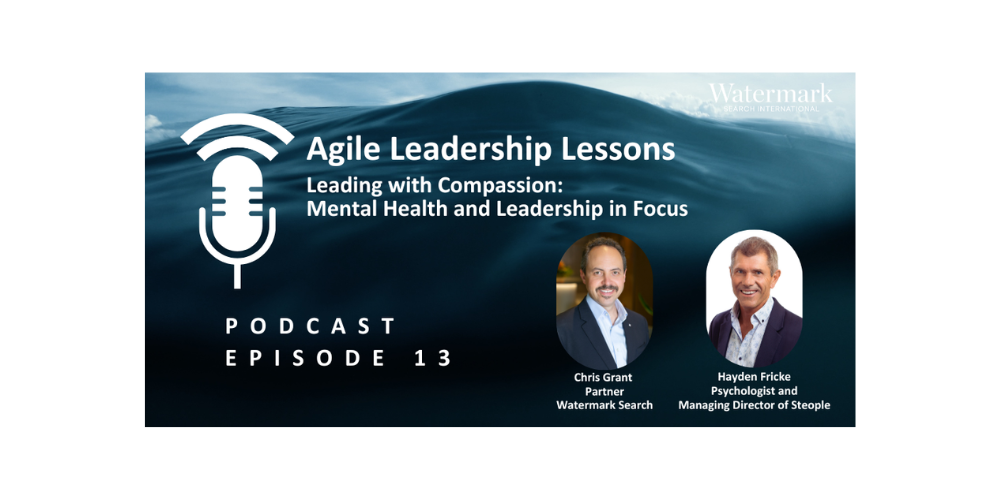
In Australia, 22% of people aged 16–85 experience a mental health disorder, whether anxiety, depression, or substance-related, within a single year (ABS & AIHW). In this special Movember episode, we explore what that means for leaders and workplaces today.
Host Chris Grant, Partner at Watermark Search, is joined by Hayden Fricke, Managing Director at Steople, psychologist, executive coach, and author of Compassion. Hayden shares what inspired his book and why now is the time to shape a more compassionate society.
We dive into:
How to think about mental health
Practical tips for improving mental wellbeing
Why leadership skills like listening and empathy matter in mental health conversations
The link between wellbeing and leadership effectiveness
Advice for new CEOs on psychological safety and vulnerability
Everyday actions leaders can take to create a culture that truly supports mental health
Hayden also reveals a personal mindset shift that changed his life and shares his hope for the future of mental health in society.
If you’re a leader, or aspire to be one, this episode offers insights and tools to help you lead with compassion and make a real difference.
Listen to gain insights and advice for current and future leaders.
You can also find the podcast on several different apps, Spotify, Apple Podcasts, Breaker, Castbox, Google Podcasts, Overcast, Pocket Casts, and RadioPublic. Click here to listen & subscribe on your favourite app or read the transcript below.
|
Leading with Compassion: Mental Health and Leadership in Focus
Agile Leadership Lessons, Episode 13, transcript:
Chris Grant, Executive Search Partner at Watermark Search International:
Welcome to the Watermark Search International Agile Leadership Lessons podcast. My name is Chris Grant and I'll be your host today. I'm a partner in our executive practice, and if this is your first time, thank you for joining us. Today, and pertinently, in the month of Movember, we're exploring the topic of mental health through a new and powerful memoir called Compassion from psychologist, author, executive coach, and friend to Watermark, Hayden Fricke.
Hayden's new book shares raw, often heartbreaking stories, while offering a psychologist's lens on the stigma, complexity, and silence that still surrounds mental health today. Mental health can be a tough and often uncomfortable topic to tackle, but important to talk about. According to the Australian Bureau of Statistics and those of the Australian Institute for Health and Welfare, one in five Australians, 22% in fact, age 16 to 85, experienced a mental health disorder, either anxiety, depression, or substance abuse in the past 12 months. And therefore, Hayden's new book is likely to be relevant to all listeners. So I'm really excited to say welcome Hayden to the virtual couch with me today.
Hayden Fricke, Managing Director at Steople:
Thanks very much, Chris. I appreciate the opportunity to come and talk with you.
Chris Grant, Executive Search Partner at Watermark Search International:
No, it's fantastic. Obviously in the month of Movember, which I know that we are both proud supporters of, I thought we could start off by you telling us a little bit about your new book, Compassion.
Hayden Fricke, Managing Director at Steople:
Thank you, yes. I'm very proud of this book. It was a labour of love for about three years or so. Compassion, and the subtext is a journey through love, loss, and understanding, of mental illness. It's a story, it's a memoir, it's a mixture of professional and personal. The personal part of it is it's about four men in my life over the last four decades that have suffered from significant mental health issues or mental illness issues.
The first person is my brother Quentin, who had schizophrenia for the last four decades and sadly passed away a bit over three years ago. The second person is my father. Who had a different sort of story. He was successful in society's terms. He was a barrister, a queen's counsel, and a judge in the county court. But he suffered from bipolar disorder and was a functioning alcoholic. A third person is my brother. And my father passed away similarly about three and a half, four years ago. My brother Craig. He's 62 years of age at the moment, so he's the only one of the four people still alive today. He has an intellectual disability. He has got an IQ of 70. He also suffers from bipolar disorder and anxiety. And the fourth person is my brother-in-law, Glenn. Who was married to my sister, Yvette, and he suffered from severe depression, bipolar too spiraled out of control and very sad story, and ended up taking his own life about seven years ago.
So the book is about those four people in my life. That have all suffered over the last four decades from mental illness. So it shares the often very sad and harrowing stories that I've experienced. But it also as a psychologist talks about how the mental health system has changed over four decades.
My reflections on schizophrenia, bipolar disorder, suicide, alcoholism, all those aspects there. And it talks about how the system has improved, but also what we need to do better going forward. And I guess I finish with, and the reason the book is called Compassion, I finish with a view that we need to get better at taking our mask off instead of having the perfect Instagram photos and saying our world is perfect. We need to be able to have the conversations that matter. We need to understand mental health better, and we need to be able to talk about it to reduce the stigma and the shame associated with it, and increase our compassion for those that are struggling.
So that's a summary of the book.
Chris Grant, Executive Search Partner at Watermark Search International:
Yeah. Thank you. I know that when I read the book, there's a lot of times where you reflect on your own personal life, and I think we're each, a brother or a son, a father. And you can point to a number of times in your life where you've been confronted by personal tragedy and the like. And I think when I was reading this book, expecting it to be a pretty heavy read, there are a lot of moments actually of levity. I found it extremely instructional. I learned a lot of lessons along the way. I even had some laughs, which I didn't actually realise I would be going to.
But tell us a little bit about what inspired you to write Compassion? Obviously you've got this story to tell, but why did you feel like now was the right time to write this story?
Hayden Fricke, Managing Director at Steople:
Yeah. That's a good question, Chris. And I think for me, firstly it was a book that I just felt compelled to write because of the story and the experience that I'd had. And certainly my sister Yvette and I who have helped my brother Quentin and my brother Craig for years together. Quite often at the end of episodes that were pretty harrowing, she said we've gotta write a book about this.
So that, just the compelling nature of some of the stories made me want to put it down. I think it was highly cathartic for me personally. So it was a personal journey. But beyond that, I feel that the combination of that, plus the fact that I'm a psychologist, I have more to say than just sad stories.
The experiences that I've had working as a psychologist for four decades hopefully give a bit more than a series of sad stories and that was certainly something that compelled me to write this. I've participated in Movember for about the last 20 years, and so it's a topic that's really passionate and close to my heart. So I felt like I really want to share a story like this so that we can maybe shape society a little bit. And have more compassion and have the conversations that matter. If I can make a small difference to people at work and in society more broadly in terms of our understanding and compassion for those with mental illness, then I'll be pretty happy.
Chris Grant, Executive Search Partner at Watermark Search International:
Yeah, most definitely. It is a quote in your book which I really which is highlighted at this. That compassion is not a virtue. It's a commitment. It's not something we have or don't have. It's something we choose to practice. I believe I say her name right? Brene Brown said that.
So appreciating that mental health is something we all experience, although I believe it's possibly often misunderstood. What do you feel are some of the most important shifts that we need to make as individuals in how we talk about and support mental health in everyday life?
Hayden Fricke, Managing Director at Steople:
Yes. And that quote is from Brene Brown, someone that's obviously very popular within the HR and organisational psychology world. And I really liked it when I looked at it because it is something that we practice and we demonstrate and we show it's not something you have. So we need to demonstrate it.
And for me, that's all about then the way we have conversations every day about this. One of the things that I think is important is that we do sometimes misunderstand even the difference between mental illness and mental health. And the way I think about this is that you may or may not have a diagnosed mental illness, so you could be high on mental illness or low on mental illness, but I think about it as if you think about mental health, it's like a spectrum. Rather than, you either have it or you don't have it.
And so there's another framework around mental health, which goes from languishing, struggling, striving to thriving. And so all of us move up and down this spectrum, often even daily. We might be striving and then we might be struggling and we go up and down and there's some models and frameworks that overlap, mental illness and mental health. So I think we get it. We need to get better at. Talking about the nuance of mental health in terms of spectrum of how we're feeling, rather than just, you either have a disorder or an illness, or you don't have one. And be better at the nuances of the way we talk about mental health and mental illness.
Chris Grant, Executive Search Partner at Watermark Search International:
Yeah, it's not a sort of off switch or on switch or what have you. As you rightfully say we are all sitting somewhere on that spectrum. I think that's helpful. In fact when you include yourself in that, and definitely there's times, whether it's through work stress or family stress or what have you, that we, I feel that, we're all at different ends of that scale.
In terms of some of the small practical things that people can do to support their own wellbeing especially when life feels a little bit overwhelming or fast paced, what are the sort of comments or what are some of the things that you'd share about that?
Hayden Fricke, Managing Director at Steople:
Yeah, really good question. I think and the concept of small things is really important. There's a great book by BJ Fogg called Tiny Habits, or there's another book that I think is read more recently and widely by James Clear called Atomic Habits. So I think it's really important to make things small, tiny when you're looking at improving your mental health and wellbeing rather than changing everything in massive ways. It's tiny things you do daily.
I've got a couple of thoughts for you that are quite practical. Probably the first one that's quite a very, a simple model or framework that people can use is just the concept of the circle of control, circle of influence. Which is, if you imagine in inside a circle, you've got a circle, small circle inside, there's everything that's within your control. You've then got another circle outside of that as things that you can influence but can't control. And then you've got on the outside things you are concerned about such a circle of concern. Often what happens is we spend so much time worrying about things we're concerned about, but we have no control over them whatsoever.
A simple but effective strategy is really learning what are the things I can control and then learning to let go of the things that I'm concerned about but have no control over. And basically you only have control over how you react and respond to the world. So it's, you have control over yourself, your thoughts, your actions, your behaviours. But you do not have control over everyone else. But sometimes we try to control things that are uncontrollable. So simply controlling the things you can, which is your own reaction to the world. So that's probably a simple but really important, powerful one.
Another one is a model called the Effort Recovery Model. Which is basically saying we all have intense periods of effort where yep, it's fast-paced environment that we sometimes feel overwhelmed and we need to have small periods, during the day, during the night, during the week, during the year where we recover after intense periods of effort.
We can't just keep going, otherwise we burn out. So it's really important that we build in even at nighttime. What's your routine and ritual when you go home? Do you feel exhausted and crash on the couch? Do you do something that gives you a sense of recovery?
For example, doing something that gives you a sense of mastery in the evening, like learning the piano or photography or something that takes you away from your daily grind. We know that while you're having a sense of mastery, we are recovering. You could even have a sauna. You could do some meditation, some relaxation, listen to some relaxing music.
Just make sure that every evening there's some level of recovery going on before you go again the next day. And the same for the weekends. What do you do on your weekends? Do you have a weekend where you feel totally exhausted and you come back to work for recovery, or are your weekends actually recovery for you?
So just really thinking about the ways that we recover on a daily and weekly basis is really important. So there's a number of small little tips there just to make sure we're, we are looking at what we're doing on a daily basis to recover from an often very fast paced environment.
Chris Grant, Executive Search Partner at Watermark Search International:
That's a really pertinent point. The recovery factor, I think a lot of people would say that they're so busy that they don't have time for themselves. But I think to be present with your family and with work you need to do that recovery piece. Whether that's through running, personally I can't get into, I've tried meditation a couple of times. I can't do it. Running is my meditation, but again, I don't do it often enough. I did watch The Block recently, I saw, every house had a sauna. I did think that was a good idea but possibly not practical for everyone.
I suppose look, talking about. Movember a little and bringing attention to men's mental health, which can be a tough topic for many. It was actually brought to to my attention the other day when I greeted a friend, and this is going back a couple of months ago actually. And yeah, it's just that, the usual greeting, how are you? And he said, ah, not good. And in that moment I had this bit of micro panic in terms of, oh no, where do I go to from here?
In terms of the conversation, I was between meetings. It was just a casual greeting. I didn't expect anything other than yeah, good. And you. And so I didn't feel very well equipped. Are there any traits or habits that in agile or resilient leaders that others can learn from?
I must admit in that particular instance, had he been serious, he moved on, said, no, I'm fine. And had a bit of a quip and a smile and then moved on. Is there anything else that you can share with us?
Hayden Fricke, Managing Director at Steople:
Yeah, it's a really fascinating point because often we do just say, good day, how you going and most people are good and you, and then you move on. You're right. You don't expect people to say. Not so good. And so if people are serious and not quipping like your mate was this is, I do talk about this in some of my talks that I give about, the RU OK day? 'Cause you ask people, are you okay? And often people don't know what to say when it comes next. If they say, no, I'm not.
The issue particularly for businesses and leaders is we often get promoted to leadership roles because we're good at fixing stuff and we're good at solving problems and we have this immediate desire to fix. And so the first reaction needs to be, we don't need to fix someone if they're not feeling good, we just need to listen. And so we need to be good at being non-judgmental and asking some follow up questions and ah. Tell me more. Ask some open questions.
If they say they're not okay you might ask, do you wanna talk about it? And they might say, no. Do you wanna talk about it later? Would you like to go for a coffee? Yes or no, but really, but it's just being available and listening. And if someone then says something again, use those micro skills in reflective listing, paraphrasing, showing empathy, showing compassion. But you don't have to fix. Just the best thing is to listen and get someone to talk as much as they want to talk, if they feel safe to talk or not. Just be there then and later on as well. So if someone says that and they don't want to talk now, you might want to follow up the next day, but really it's just being the best listener with the most support and empathy you can without fixing.
Now, if you do that and someone feels safe enough to open up to you. Eventually you may want to go beyond just listening and see if they want to get help, and then you might help them to find a psychologist or find someone to talk to. But that's not until the third or fourth or fifth conversation the first bit is just be a really good listener.
Chris Grant, Executive Search Partner at Watermark Search International:
That's really interesting. And it causes me to reflect on something that I'd probably handled fairly poorly in my own marriage when my wife was talking about her day and how hard it was. And immediately I went to solution mode. Because I think my former thoughts on it definitely, and the way I operate is definitely try and get to a solution. I'm not sure if you know everyone's wired that way. And I used to see that as, anyone that wanted to talk about it, but not solve it as a weakness. And she almost used exactly the same words that you've used. She said, I don't need you to solve this problem for me. I just need you to listen to me. And I had a hard time to be honest processing that because in my mind. It came across as you are complaining and you just want someone to and I would get frustrated, but then I've since learnt to lean into it and just support and not necessarily have to jump straight away into solution mode. It's been marvelous for my marriage, put it that way.
Hayden Fricke, Managing Director at Steople:
Yeah, well done, Chris. I think it's this is often something that, we talk about there's a difference between men and women that men typically do want to fix or solve problems, but not always. It can be either sex that try to do that. So if you, if we get rid of the differences between the genders and the way we try to think about things just feeling heard is such an important thing.
Feeling heard and understood is what we're trying to do. And then that helps the person, if they want to go further and get help, then they will do that in their own time and they'll be intrinsically motivated rather than extrinsically motivated to want to do something about it. But it's the listening and the understanding and the feeling heard that has to come first.
Chris Grant, Executive Search Partner at Watermark Search International:
Absolutely. Now obviously we talk about this being the Watermark Search International Agile Leadership Lessons Podcast. So I suppose, a lot of our listeners are executives. What do you see, or how do you see wellbeing and mental health influencing leadership effectiveness today? Are there traits or habits, a again, that you see are particularly effective in a workplace setting? And how can leaders be more effective at being better at their job of leading people?
Hayden Fricke, Managing Director at Steople:
Yeah, as you know, I have been an organisational psychologist for nearly 30 years now, and I run a business called Steeple. And so I work in this very space. And and I actually wrote a book about four years ago on this exact topic. And it's called Leaders, Do You Have Your Shit Together? And it's how leaders need to take care of themselves first before they take care of their team members, if you like. So a bit like the analogy of, getting on a plane and making sure you've first put your own mask on before helping others.
So I see that there's two things that connect the two together. One is leaders need to be able to take care of themselves first before they help others. So that's one. The second one is I think that leaders need to be able to drive both performance and wellbeing in the way they lead. And the key word there is and. Often I think people think of it as or. It's either performance or wellbeing.
And I think no, it's both. Because if you want sustainable performance and not burning out people, you wanna drive long term performance. So you have to take care of yourself first, but then you have to make sure that the competencies or capabilities you demonstrate straddle across both of those areas.
So all the things we've talked about earlier and more. In, in, in my first book are about taking care of yourselves and making yourself with effort, recovery, circle of control. There's many other models and frameworks that you can learn, but firstly just, making sure that is something you, you get, you understand that you're not gonna be a great leader if you don't show up well. And we're not gonna show up well every day if you are struggling with all sorts of things in life. So that's probably first lesson.
But the second one is when you think about and maybe I'll actually, I'll talk about resilient leaders as well. There are some competencies or capabilities that we need to take care of ourselves. Things like an open mindset. Carol Dweck's work on growth mindset rather than a fixed mindset. Having a an open curious growth mindset really helps us to be more resilient. Where if we've got a fixed mindset and a mindset that's very black and white, then that doesn't help other people. But it doesn't help ourselves either. It makes us less resilient to things.
Another one is around Kristin Neff's written a book on self-compassion. It's really important that we have compassion for ourselves because if we don't have compassion for ourselves, we're gonna be harsh on ourselves and harsh on others. And often what happens is we then feel insecure within ourselves, but we try to cover that up by being overly certain and overly dogmatic about things.
So self-compassion underpins really good behaviours. Another concept that is by Adam Grant that I really like is confident humility. And I like that because, we need to be humble, but we need to be confident. So people don't want a leader that is arrogant, but they also don't want someone who's lacking in confidence and has anxiety and self-doubt.
So this concept of confident humility straddles that really nicely. So they're just some of the competencies, I think, or capabilities a leader needs to be resilient and to take care of their own wellbeing.
I won't go through it now, but in terms of taking care of others and driving performance and wellbeing we've actually got a framework and a tool and some research that we did at Steeple in conjunction with Deakin University about 10 years ago and came up with a framework that has seven capabilities that leaders need to demonstrate to drive both performance and wellbeing. So for example, building capability and accountability in your people both drives performance but also drives wellbeing because people want to be developed and coached and developed. Another one is all around consistency. Leaders that chop and change all the time don't drive performance 'cause you're all over the place. But also don't drive wellbeing. So being consistent in the way that you lead drives both performance and wellbeing.
Another one is all around being able to build trust and psychological safety. So if you can build trust and psychological safety with your team, that is the foundation for both performance and wellbeing. So that's just three of seven factors that leaders need to demonstrate to be able to drive both performance and wellbeing in others.
Chris Grant, Executive Search Partner at Watermark Search International:
It's funny that you talk about building trust and psychological safety. I know a lot's being said about it, but time again I see that showing up in references that I take when, we're at the final stages of an interview process, and it is so important in terms of teams showing up, particularly in this day and age where teams are a little bit discombobulated. Not everyone's in the physical space. You can't always coach in the moment. Or be there to see whether or not what you've said has landed well. And, the person hasn't gone off and huddled in the corner or what have you. So I think that building that trust and psychological safety in this day and age is a real really important. I can't stress it enough. And that consistency as well. A lot of people talk about that in terms of teams, particularly in 360s.
Hayden Fricke, Managing Director at Steople:
Chris, I think just to quickly add to that I think there's two aspects there. The trust and psychological safety are different concepts, but they overlap. I see them as like a Venn diagram if you like. And so on the trust side a lot of people talk about it, but they don't know how to do it. Because it's such a nebulous concept, so you need to make sure you understand the inputs to creating trust. One from an output perspective there's a great book by Stephen MR Covey. So it's the original Stephen Covey's son, and it's called the Speed of Trust. And it basically shows that once you have trust, you can get stuff done really fast. So it drives performance, but it takes a lot of work, deliberate work to build the trust in the first place. So that's a great book if people are interested in how do you build trust and the speed of trust and the connection between trust and performance.
And the other one on psych safety. Similarly though this concept has been around for a little while now, probably at least 10 years by Amy Edmondson, but a lot of people still struggle to go. How do I create it as a leader? And again, there are some practical things you can do on a daily basis to create psychological safety, which by the way, is where people feel safe to speak up. And once we've got that speak up culture, then we can actually drive performance as well, because you're getting input from all sorts of people, which is necessary for sustained high performance.
Chris Grant, Executive Search Partner at Watermark Search International:
Yeah, it's interesting. I think we used to call it trust tokens. You need to have your trust tokens in the bank. When I was managing a team, I think that's sort of 2005, 2006, that was a concept that they put to me then, and I I didn't understand it necessarily. So before you're asking, things of people and pushing them, you really do need to build that trust.
And that was so important. But yeah, I think I, I learned a couple of those lessons early on and then tried to build those trust tokens in that bank and build up so that you could take out, some of, do some withdrawals later on. But if we are talking about our audience, a lot of which will be in executive positions and a number of which obviously are gonna be leading teams naturally.
Some, CEOs and the like, where does a CEO go? In terms of CEOs oftentimes, thought to have all of the answers. And again, if you are new in a CEO role, you might not want to demonstrate that vulnerability to a board chair or board, et cetera. What sort of. I know they're going a little bit off topic here, but what sort of advice would you give a newly installed CEO in terms of getting some runs on the board and placing them themselves well within the context of a new organisation so that they can, start to get runs on the board and psychologically feel safe themselves.
Hayden Fricke, Managing Director at Steople:
Oh, that's a really good question. Wow. We could spend an hour just on that one question on Chris. I do a lot of executive coaching. I'm probably coaching about eight or so CEOs of different organisations right now. And I think one of the things I first thought of when you asked that question is that CEOs are often in a very lonely kind of position because they can't really confide in their direct reports really vulnerably.
If they've known them for a long time, they can. But if it's new, then you know they can't really open up to the chair of the board and the board. So they're often very lonely. And that's why, they often do find it really helpful to have a coach. And often the CEOs that I work with, if I help them to feel psychologically safe, then what I want them to do is be vulnerable and open up and take the mask off.
And when I do that. Most of the CEOs I work with end up sharing lots of vulnerabilities and lots of worries and concerns that they have, but they can't share with anyone else. So I guess, you know, if you are a new CEO and you haven't had a coach. Finding a good coach that can actually make you feel safe where you can talk through things is really helpful. And if you don't have a, an executive coach, then find a mentor or a buddy or someone that you can trust. I have seen some situations where a really good HR director. Can be that sounding board for the CEO. But again, that's a tricky relationship because there's a power dynamic between the HR person and the CEO as well.
So that sometimes doesn't work. But I have seen that work where the CEO really trusts the head of HR and that can happen as well, but regardless of that is try as a CEO not to think you have to do it alone. There are ways that you can get support and you don't have to be perfect as a CEO. In fact, if you are perfect, that is one of the problems, is not to be perfect and not to be the smartest one in the room because that creates intimidation for other people.
So have a certain amount of confident humility and vulnerability in the way you work on things. And probably one more point, Chris, before I throw it back to you, is I think that all starts with self-awareness. If you are not aware of yourself, in a really deep way, and you're a subject matter expert, 'cause often CEOs come up through the ranks and they're an expert, whether it's in marketing or finance or IT or engineering or law or whatever the expertise is. And they have to learn to let go of that knowledge, expertise, and be a real leader. And some leaders that I work with struggle with that. It's the letting go of their crutch of the knowledge. And actually really leading rather than being the knowledge expert. You've got your executive team that are the knowledge experts in different areas. You need to let go of all of that. And so you need probably a combination of really high self-awareness and that vulnerability and humility to be able to even recognise that's where you're at.
Chris Grant, Executive Search Partner at Watermark Search International:
Absolutely. It's interesting, and this is a bit of a sideways segue perhaps, but recently we've been watching The Golden Bachelor. I don't know if you've taken in an episode.
Hayden Fricke, Managing Director at Steople:
I have not, but I'm interested in where this is going, Chris.
Chris Grant, Executive Search Partner at Watermark Search International:
I did say that we might go into some weird and wonderful segues, but the Golden Bachelor obviously if you're familiar with the Bachelor series typically you're getting a young hunk of a guy. And there's about 20 women presented and they all vie for his heart. But a lot of the time there's quite a bit of conflict in those shows and people playing off against one another. A lot of egos and the, the Golden Bachelor has drawn me in a little bit strangely because of the vulnerability shown.
I think, we're talking about people in their fifties and sixties. And it just seems that, they've all gone through a lot of hardship and they share a lot of the hardship. Divorce and death and anxiety and all of these types of things. Not, not only does it make it compelling viewing, but I really found that I was getting really pulled into these stories.
And it's funny because the cohort of women instead of going at one another have come together and it seems like they've formed a really good friendship. So more so than winning the heart of the Bachelor, they've actually won a number of friendships at a time in life where it's hard to make new friendships.
And I felt that vulnerability piece put a really interesting spin on not only the show and made it more interesting for me. But equally those stories and the sharing of those stories really brought people together. It was actually amazing to watch on tv appreciating the fact that maybe the Golden Bachelor is not for everyone.
But in any case, if you haven't seen it probably doesn't mean much to you, but interesting nonetheless, in terms of the vulnerability piece that you talk about and sharing that vulnerability and how that draws people in.
Hayden Fricke, Managing Director at Steople:
Yeah, just a brief connection. I didn't know where you're going with this, but it is a really good story and segue for leaders though, because what we find is that a leader that is able to be vulnerable. It draws people in, as you've said. The vulnerability, the humanness, the realness of vulnerability.
And what I've seen happen is when really good leaders who are able to be appropriately vulnerable, what happens is the rest of the executive team, if it's a CEO, steps up and supports them and lift them up and feels connected to them in a really deep way. Whereas a leader that puts a mask on and tries to be perfect and tries to be the smartest one in the room and is afraid to let their guard down. That has the opposite effect that pushes people away. That makes them feel intimidated and doesn't create the trust and the psychological safety. So vulnerability is one of the factors sitting below psychological safety. If you can share vulnerability, it increases your level of psych safety.
Now there I should put a caveat on this. People don't quite understand what that means. Sometimes they think it's sharing your deepest, darkest secrets and it's not. So it's appropriate vulnerability. And again, in the time of the podcast, we probably haven't got time to go through that, but if you can share appropriate vulnerability, it draws people to you.
Chris Grant, Executive Search Partner at Watermark Search International:
Absolutely. Talking about that culture and connection piece, you did say before the HR person could be a great confidant to the CEO. I suppose it's harder to be able to weigh the balance right at the get go. Once you've joined an organisation, as you rightfully say, it's important to build that trust and trust is built over time.
And as you said might be sped up through sharing vulnerability, what can organisations do and heads of HR and HR teams, to create cultures that genuinely support mental health? Not just through policies, but through everyday behaviours and leadership.
Hayden Fricke, Managing Director at Steople:
Yeah, good question. Let me start by saying. And I start with what is culture? And there's lots of different definitions, but my, the simplest one is just the way things are done around here. Or another way of thinking about this is the daily habits and behaviours and expectations that are shared or shared norms. It's linked to kind of social norms, which is almost the unwritten rules about the way things are done around here. So first of all, just understand what is culture.
But then you go, what are the levers for change on culture? And we know through a lot of the research that's been done over the years that roughly 70% of culture is shaped by the daily habits and behaviours of leaders.
So what are the leaders doing when they show up? So it's your most powerful leader. Even if that research is wrong, and it says 50%, it's the biggest one. There are other things, by the way, systems, structures, processes. So you, your reward systems, your performance management systems your organisational structure and design, your policies, your procedures. So they all do have an effect, but the biggest is your daily habits and behaviours of leaders. And when I say leaders, I'm thinking of all levels of leadership. It probably begins with the CEO and or the chair. So it's the board, it's the chair, it's probably the CEO has the most impact. And then the executive team, but also the senior leaders and right down to frontline leaders. So it's all leaders and eventually it's everyone. But it is it's the alignment, but it has to begin somewhere. And if. If you've got a leader, a CEO that's demonstrating very poor behaviours, then that sort of really encourages others to do that, particularly over time. So that's probably the first thing is just to recognise the power of leadership behaviours.
And I like to think about it as behaviours that when no one's watching you. So it's not when you're up in a pedestal, but it's the conversations you have when you don't think you're being observed. That's how are you behaving in that way? And this to me goes through from does a leader take care of themselves.
One of the reasons I wrote the book, Leaders, Do You Have Your Shit Together? I saw probably after the global financial crisis back in 2007, 8, 9, it was a lot of drive for increased performance and productivity. A lot of leaders were being told to drive a accountability and to live performance. What we saw was an increase in claims for bullying, harassment, and other issues around psychosocial health. Creeping up and so in, but instead of dealing with the root cause, what happened was we saw the rise of, 10,000 steps programs, fruit bowls and massages and things like that, that didn't really deal with the root cause.
It was leaders that need to have the skills to both drive performance and wellbeing to look after their people and show care for them, and compassion as well as driving performance. And leaders need help to do that. They don't know how to do that. And which starts with taking care of yourself. How do I show up each day? So leaders need training, development, coaching, whatever you wanna call it, to help them to actually walk the talk. Instead of getting a wellbeing manager to go and fix wellbeing, the leader needs to try to walk the talk. And that's hard to do. They're looking after yourself. So leaders need help to be able to walk the talk, to demonstrate this in the way they carry themselves every day.
Little things could be, for example, whether or not they might want to go for a run at lunchtime and actually tell people, I'm going for a run instead of, or leave the office early and it's to do something for your family or whatever. Rather than, role modeling starting at six, finishing at seven at night, whatever, working on weekends. So all the little thing, all the little messages the leaders are doing shows what's expected around here, and then others follow that. So it's really walking the talk as much as you can and then helping others to do the same.
Chris Grant, Executive Search Partner at Watermark Search International:
Yeah, very important point. And you make it in your book as well around micro skills, and we've talked about it as well. Micro habits. Micro skills. This question might be redundant, but maybe there's a different element on it. I think if you talk to leaders, most leaders will say I walk the talk. But there's possibly areas of improvement, like for all of us.
I think when we spoke about, putting together the podcast we talked about micro habits. Not necessarily about micro about mental health. And you shared some anecdotes with me about, every year I think I, I said to you that I start the year and I'm gonna do X, Y, and Z. I'm gonna be fitter, more intelligent, more professional, I'm gonna learn new skills. And then, we get to this time of year, November and I'm thinking, oh, I could have done so much more this year. But then, December rolls around in January and then I make all of these commitments again.
So how would you help leaders from knowing about wellbeing and feeling that they do wellbeing and or, leading teams well to actually living it in their teams and or personal lives.
Hayden Fricke, Managing Director at Steople:
Yeah, great question. As psychologists we call this the knowing doing gap. And with respect to wellbeing, we probably know more today about wellbeing than we ever have in our history. And yet wellbeing is probably poorer than it's ever been, particularly anxiety and depression. So there is this knowing doing gap.
We know what we should do, but we don't do it. So that's when I get interested, why, what is it? And there's a whole complex range of things going on there. But if I just take one simple concept, you might remember a little while ago I talked about tiny habits from BJ Fogg. And then James Clear's book on Atomic Habits. BJ Fogg has this great example of how you make habits tiny. I think the New Year's resolution one's a good one too. 'cause we try to make things too big or we have too many goals. So the simplest way is to make sure that that goal or that commitment that you make is tiny.
And BJ Fogg uses the word laughably small. If that's even not achievable, make it laughably small, make it smaller and smaller until it is actually achievable. And he uses this lovely example where he was a runner and he also used to drink a fair bit of water to hydrate himself, but he realised he wasn't doing any weights or he wasn't strong in his upper body.
He'd never really done anything there. So he wanted to, get into the habit of doing pushups. So he talks about this concept of there's something that you do every day that's a trigger. You need to link a new habit with this trigger. And make it small. So for him for him building a habit of doing pushups in order to over the long term build strength, he said I drink a lot of water and so I go to the toilet to pee about five times a day. So every time I pee, it's gonna be a trigger to just do two pushups straight after I pee. So he did that for a month. He said, I'm gonna do this for a month. So he basically did roughly 10 pushups every day after he peed for a month. And that built a habit of just doing pushups. Now that didn't make him super muscly and super strong, but it built a habit.
Then he said, right next month I'm gonna increase that to five or 10. I can't remember the rhythm. Eventually he had this rhythm of doing more pushups. I think he got to a hundred in a day every day and he started getting strong. So it's that sort of simple approach to a new daily habit that is really quite powerful if you want to go from knowing to doing.
Chris Grant, Executive Search Partner at Watermark Search International:
Yeah, absolutely. I love that concept of laughably small. Reminds me in the lead up to, oh, this is going back a number of years ago now. I would constantly push out homework. And one day I supposed to do half an hour, I didn't do it. So the next day I had to do an hour. I didn't do it.
So on Wednesday I supposed to do an hour and a half, two hours, et cetera, and it built, and that just wasn't getting done. And then someone at that time this said why don't you just do five minutes, five minutes of homework? And it was that habit of five minutes of homework and they're like, oh, five minutes is already up. Then you build that to 10, 15. So definitely resonates with me. Thank you for sharing that. It's a great story.
I suppose just in terms of great stories, you shared one then that was from another person that you'd spoken to, in reference to personal reflections and takeaways. What's one personal habit or mindset shift that's made a meaningful difference in your own wellbeing?
Hayden Fricke, Managing Director at Steople:
Yeah. Thank you. It's hard to think of just one, but probably if I extend that concept of tiny daily habits. I have tried to, obviously, I coach others, I work with others, and I try my best to walk the talk. Now, obviously I don't get it right all the time either. But one of them is to think about what I do from the time I wake up in the morning.
To the end of the day and just build some good habits there. So I get up in the morning and do some kind of exercise and activity pretty much seven days a week. There might be an occasional day that I miss because of something that's going on, but just that habit of getting up and mixing it around and changing it so it's not the same thing.
And then as well as the exercise that I might do I try to build in some breathing and some mindfulness at the same time so that before the day gets going, I. I'm in a good frame of mind. I'm ready to go. And I think that helps me in a really good way.
And I'll probably add one more. At the back end of the day, I am pretty disciplined around when I try to get to bed and the habits and the hygiene factors at the end of the day around having good sleep and preparing for a good sleep so I can then recover and go again. So at either end of the day, whatever happens in the middle of the day, I feel like I've got some good habits that really help me feel in the right mental shape to show up the best that I can.
Chris Grant, Executive Search Partner at Watermark Search International:
Thank you. I've been madly scribbling notes here on the Speed of Trust and Steven Cubby, and I've got about five books to take away. Talking about books though where can people find your book Compassion and how can they connect with you or learn more about your work?
Hayden Fricke, Managing Director at Steople:
Thank you. Great. So Compassion is available on a number of different locations. So you can, if you just Google Compassion by Hayden Fricke, you'll see a number of locations where you can find it. It's on Amazon it's on Booktopia. It's a number of other book locations online. You can find it.
It's not in bookstores, so you'll need to go online. Or I do have a website, which is my personal website, haydenfricke.com. It's available by purchase there. And people can get in touch with me through either the Steople website, look at us on Steople, which is STEOPLE, which stands for success through people. So find out more about us there. I'm more than happy for people to email me on my email address directly and have a chat about anything that's come up as well, which is hfricke@steople.com.au.
Chris Grant, Executive Search Partner at Watermark Search International:
Thank you. I must admit, as someone who buys quite a few books and shelves them almost immediately, I picked this up obviously to read it ahead of our podcast today. I literally couldn't put it down. It is such good reading. It was like a, we talked about it at the outset before we went live, a rollercoaster of emotions, but you come outta the other end feeling a little bit more enlightened, a little bit more compassionate with some level of appreciation for mental health issues, which we talked about right from the outset. One in five people have experienced in the last year. I think about how I show up to my family and my work as well. So I couldn't recommend the book highly enough outside of doing this podcast with you, it's amazing. Well done for taking the time to, to write this down.
And I really encourage everyone listening to the podcast to go out and grab a copy of Compassion. If you can, I suppose in closing. And finally as we reflect on Movember and the broader theme of wellbeing, what's one hope that you have for the future of leadership and mental health?
Hayden Fricke, Managing Director at Steople:
I think if I were to try to narrow it to one thing, it's really that we as a society can take our mask off of perfection and trying to show the world that we're all absolutely fine and actually have real conversations that matter. And that doesn't mean all the time saying things are terrible. But being able to sometimes open up and have really important conversations that matter so that we can reduce the stigma, reduce the shame with mental health issues if someone is struggling, and therefore lead to a more compassionate society.
Chris Grant, Executive Search Partner at Watermark Search International:
Fantastic. Thank you so much, Hayden. I've really appreciated your time today and no doubt people listening to this podcast would also appreciate your insights as well. So thank you very much for taking part in our podcast. Much appreciated.
Hayden Fricke, Managing Director at Steople:
Thanks Chris.